

The fundamental drivers of recent developments in euro area housing investment
Prepared by Johannes Gareis
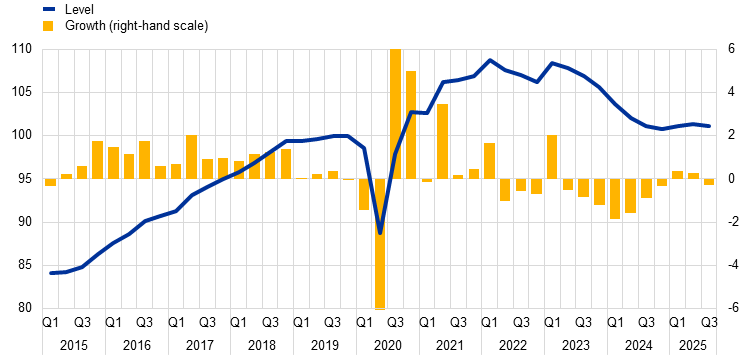
Euro area housing investment appears to have bottomed out, but a sustained recovery has yet to emerge. After increasing noticeably from mid-2015 to early 2022 – with a brief interruption during the COVID-19 pandemic-related downturn – housing investment declined relatively steadily from the first quarter of 2022 before reaching a trough in the fourth quarter of 2024 (Chart A). Although it picked up somewhat in early 2025, momentum has remained subdued. Housing investment declined by 0.2% in the third quarter of 2025 compared with the previous quarter, standing around 7% below its peak in the first quarter of 2022. Between the first quarter of 2022 and the third quarter of 2025, developments differed markedly across euro area countries. Among the largest euro area economies, such as Germany and France, housing investment declined substantially, while it increased in Italy and Spain.[1] This box uses a structural empirical model to decompose recent developments in euro area housing investment into their fundamental drivers and discusses the short-term outlook for housing investment growth.[2]
Chart A
Housing investment
(left-hand scale: index: Q4 2019 = 100; right-hand scale: quarterly percentage changes)
Sources: Eurostat and ECB staff calculations.
Notes: In 2020 euro area housing investment declined by 10.0% between the first and the second quarters, before increasing by 10.3% between the second and the third quarters. The latest observations are for the third quarter of 2025.
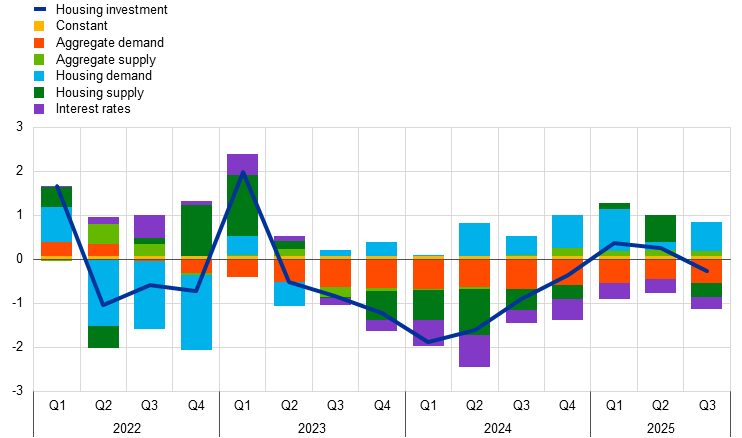
An empirical model was used to analyse the fundamental drivers of recent housing investment dynamics at the euro area level. The structural Bayesian vector autoregression model examines housing investment in the context of broader economic activity, prices, house prices and financing conditions, allowing developments in housing investment to be decomposed into a small number of economically meaningful drivers.[3] These drivers include changes in overall demand and supply conditions in the economy, housing-specific demand and supply factors, and shifts in interest rates.[4] Housing-specific demand shocks capture shifts in households’ willingness to invest in housing, such as changes in preferences, while housing-specific supply shocks reflect disruptions to construction activity, such as material shortages or increases in construction costs. Interest rate factors summarise changes in financing conditions, reflecting movements in short and long-term interest rates over the monetary policy tightening and easing cycle.
Recent housing investment dynamics have remained subdued so far, owing to weak broader macroeconomic conditions and the lagged effects of past monetary policy tightening, although this has been somewhat offset by improving housing-specific demand. The model suggests that during the pandemic housing investment was boosted by stronger housing demand. This likely reflects shifts in household preferences, including greater demand for larger living spaces owing to the increase in remote working. With the end of the pandemic, this increased demand normalised, leading to negative housing demand shocks that depressed housing investment in 2022 (Chart B).[5] Thereafter, adverse aggregate demand shocks – reflecting the broader slowdown in economic activity amid the energy price shock and heightened uncertainty following Russia’s invasion of Ukraine – became more prominent. Meanwhile, negative housing supply shocks, which pushed up construction costs and house prices, further dampened activity. These effects were exacerbated by interest rate shocks, reflecting the lagged impact of the interest rate increases following the 2022-23 monetary policy tightening in response to the surge in inflation. The negative impact of these shocks peaked in the second quarter of 2024. More recently, the drag from interest rates has begun to diminish following the easing of monetary policy. At the same time, aggregate demand shocks have remained persistently negative, potentially reflecting heightened uncertainty related to geopolitical and trade tensions and still subdued consumer confidence, which continue to weigh on broader economic developments. Conversely, housing demand appears to be recovering, as indicated by positive housing demand shocks and the relatively rapid rebound in house prices. This rebound started earlier than the rebound for housing investment, with prices having risen robustly since the first quarter of 2024.[6]
Chart B
Model-based drivers of recent housing investment dynamics
(quarterly percentage changes and percentage point contributions)
Sources: Eurostat, ECB, and ECB staff calculations.
Notes: The chart shows the contemporaneous and lagged effects of identified structural shocks derived from a structural Bayesian vector autoregression model with sign and zero restrictions on quarterly housing investment growth. The constant represents the estimated trend growth rate of housing investment dynamics.
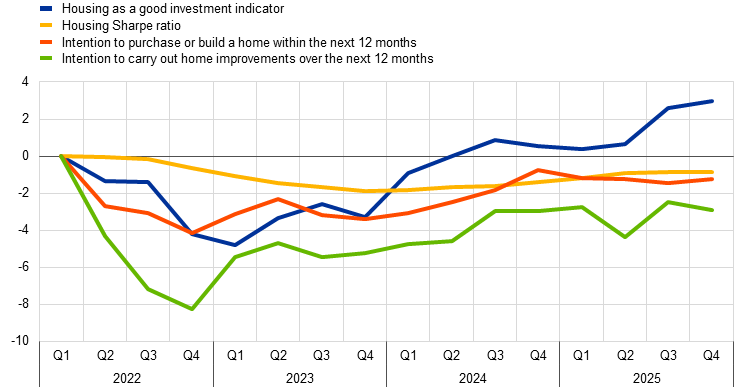
Looking ahead, the upward momentum in housing investment is expected to become more sustained. Housing investment is likely to grow as housing demand continues to strengthen, broader economic growth improves and the effects of past monetary policy easing feed through. This is consistent with evidence that recoveries in housing demand typically precede adjustments in housing supply, reflecting planning delays and construction lead times. It is also corroborated by the ongoing recovery in housing loans and a rebound in housing transactions.[7] Moreover, consumer sentiment towards housing has been improving for some time, as reflected in the Consumer Expectations Survey (CES). The survey results show that a rising number of households consider housing to be a good investment and indicate an increase in the CES-based Sharpe ratio (Chart C). In addition, according to the European Commission’s consumer survey, both households’ intention to purchase or build a home and their intention to carry out home improvements have trended upwards following a trough in the fourth quarter of 2022. Together these indicators point to strengthening housing demand, in line with the model-based evidence, and support a more favourable outlook for housing investment.
Chart C
Housing sentiment
(differences in indicators relative to the first quarter of 2022)
Sources: CES, European Commission, and ECB staff calculations.
Notes: The housing as a good investment indicator measures the share of respondents in the CES who consider buying a property in their neighbourhood at present to be a “good” or “very good” investment. The housing Sharpe ratio is derived from households’ house price expectations in the CES combined with a measure of the risk-free interest rate (see Battistini et al., 2025). Short-term intentions to purchase or build a home and to carry out home improvements are taken from the European Commission’s consumer surveys and are reported as percentage balances. The CES data represent quarterly averages. The latest observations are for October 2025 for the CES data and the fourth quarter of 2025 for the European Commission data.
References
Battistini, N., Baumann, A., Gareis, J., and Rusinova, D. (2025), “Has housing regained its allure? Insights from a new survey-based housing Sharpe ratio”, Economic Bulletin, Issue 8, ECB.
Battistini, N. and Gareis, J. (2025), “The fundamental drivers of euro area house prices”, Economic Bulletin, Issue 2, ECB.
Battistini, N. and Gareis, J. (2024), “Housing investment and the user cost of housing in the euro area”, Economic Bulletin, Issue 3, ECB.
Höynck, C., Roma, M. and Schlieker, K. (2025), “Developments in the recent euro area house price cycle”, Economic Bulletin, Issue 2, ECB.
Leamer, E. (2007), “Housing IS the business cycle”, Proceedings – Economic Policy Symposium – Jackson Hole, Federal Reserve Bank of Kansas City, pp. 149-233.
Lenza, M. and Primiceri, G. (2022), “How to estimate a vector autoregression after March 2020”, Journal of Applied Econometrics, Vol. 37, Issue 4, June, pp. 688-699.
Nocera, A. and Roma, M. (2017), “House prices and monetary policy in the euro area: evidence from structural VARs”, Working Paper Series, No 2073, ECB, June.
Richard, M. (2025), “Working from home: Effects on housing demand and inequality”, The ECB Blog, 8 January.
Smets, F. and Jarociński, M. (2008), “House prices and the stance of monetary policy”, Working Paper Series, No 891, ECB, April.
Legal Disclaimer:
EIN Presswire provides this news content "as is" without warranty of any kind. We do not accept any responsibility or liability for the accuracy, content, images, videos, licenses, completeness, legality, or reliability of the information contained in this article. If you have any complaints or copyright issues related to this article, kindly contact the author above.
