

Sauces and Condiments Market Forecast 2026–2036: Global Market to Reach USD 240.91 Billion by 2036 at 5.60% CAGR
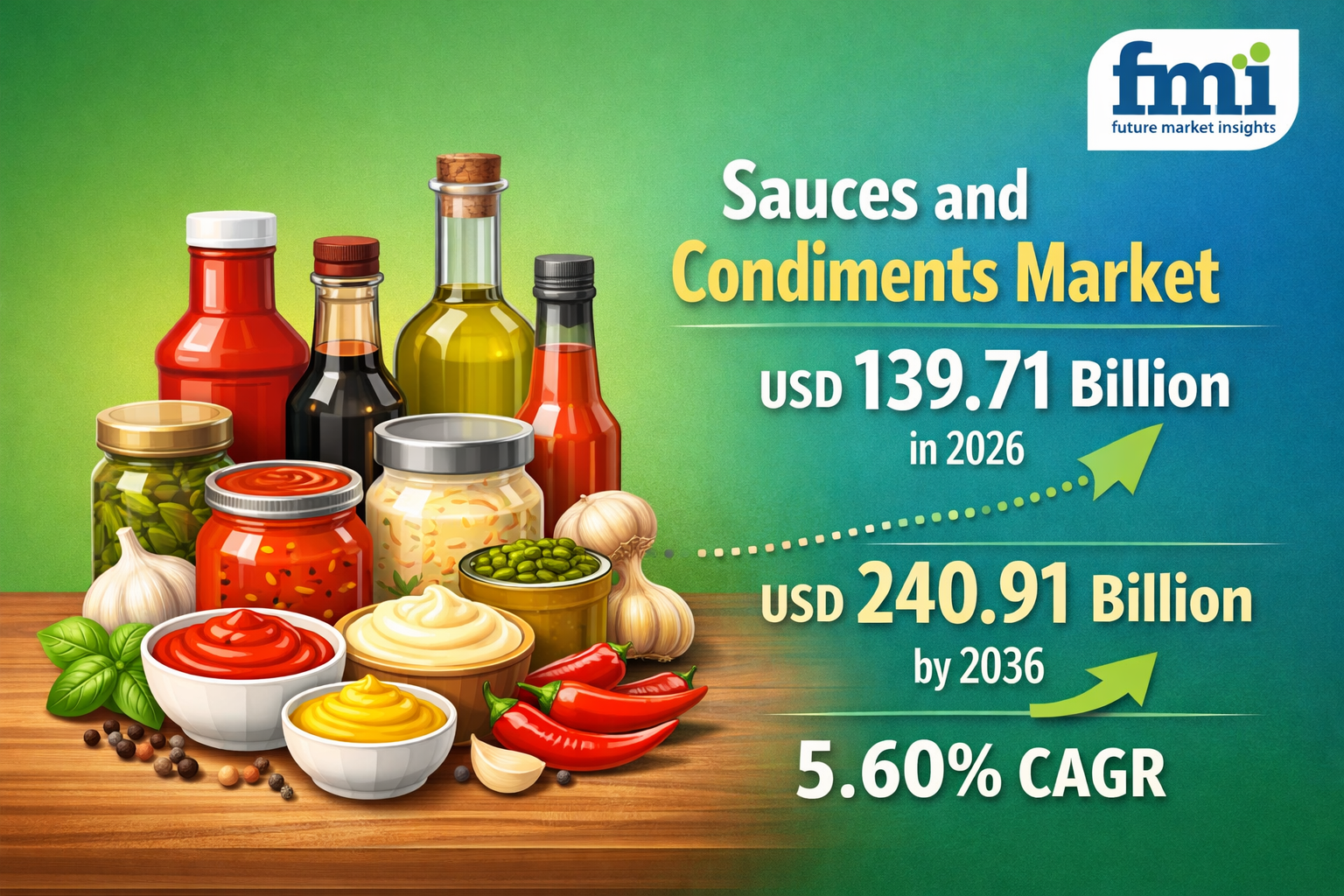
Sauces and Condiments Market
Global sauces and condiments market grows steadily, driven by global cuisine trends, at-home cooking demand, and innovation in flavors and formats.
NEWARK, DE, UNITED STATES, March 25, 2026 /EINPresswire.com/ -- According to analysis by Future Market Insights (FMI), the global sauces and condiments market is entering a phase of steady expansion as globalization of culinary preferences, rising at-home cooking culture, and product innovation redefine consumption patterns across both retail and foodservice channels. Increasing consumer demand for flavorful, convenient, and ready-to-use food solutions, combined with the growing influence of international cuisines, is reshaping product development, distribution strategies, and competitive dynamics across the industry.
The market was valued at USD 132.30 billion in 2025 and is projected to reach USD 139.71 billion in 2026. Over the forecast period, demand is expected to grow at a CAGR of 5.60%, ultimately reaching USD 240.91 billion by 2036. This growth trajectory reflects sustained demand for diverse flavor profiles, with premiumization and global cuisine adoption driving higher value realization across product categories.
Get Access of Report Sample: https://www.futuremarketinsights.com/reports/sample/rep-gb-25699
Sauces and Condiments Market Snapshot
• Market Value (2025): USD 132.30 Billion
• Forecast Value (2036): USD 240.91 Billion
• Forecast CAGR (2026–2036): 5.60%
• Leading Product Type: Soy Sauce (34.7% share)
• Leading Form: Liquid (62.9% share)
• Leading Distribution Channel: Supermarkets/Hypermarkets (46.8% share)
• Top Growth Market: China
Global Flavors and At-Home Cooking Trends Driving Demand
A primary force shaping the sauces and condiments market is the globalization of culinary traditions. Consumers are increasingly experimenting with Asian, Latin American, and Middle Eastern cuisines, driving cross-cultural adoption of soy sauce, hot sauce, and specialty condiments across Western households.
At the same time, at-home cooking habits remain structurally elevated following the pandemic period, sustaining demand for sauces that enhance flavor variety and convenience. This has positioned sauces and condiments as essential pantry staples in both developed and emerging markets.
Premiumization is also gaining traction, with artisanal, organic, and region-specific sauces creating new growth opportunities and enabling brands to command higher margins.
Retail Expansion and E-commerce Reshaping Distribution
Distribution dynamics in the sauces and condiments market are anchored by supermarkets and hypermarkets, which account for 46.8% of total share due to high product visibility and consistent consumer footfall. These retail formats continue to dominate as high-frequency grocery purchase channels.
However, online retail is emerging as the fastest-growing distribution channel, enabling specialty and imported sauce brands to reach consumers beyond traditional geographic limitations. E-commerce platforms are also facilitating direct-to-consumer strategies, subscription models, and niche product discovery.
This omnichannel expansion is enhancing accessibility while allowing brands to diversify their market reach and strengthen consumer engagement.
Liquid Format Leads Product Adoption
By form, liquid sauces dominate the market with a 62.9% share, reflecting their widespread use in cooking, marination, and table-top applications.
Growth in this segment is driven by:
• Ease of use and convenience in meal preparation
• Immediate flavor enhancement across cuisines
• Broad availability across mass-market and premium segments
Liquid formats continue to align with fast-paced consumer lifestyles, reinforcing their dominance in both household and foodservice applications.
Soy Sauce Maintains Leadership in Product Segment
Soy sauce remains the leading product type, accounting for 34.7% of market share in 2026. Its dominance is supported by its foundational role in Asian cuisines and its expanding presence in global cooking practices.
The segment benefits from:
• Strong integration across multiple cuisines
• Rising popularity of umami-rich flavors
• Innovation in low-sodium and organic variants
As global consumers increasingly embrace Asian culinary traditions, soy sauce continues to maintain its position as a staple ingredient across households and restaurants.
Asia-Pacific Leads Global Growth Momentum
Regionally, the sauces and condiments market is witnessing strong growth across Asia-Pacific, driven by urbanization, rising disposable incomes, and expanding retail infrastructure.
Sauces and Condiments Market Growth by Country (2026–2036):
• China: 7.6%
• India: 7.0%
• Germany: 6.4%
• France: 5.9%
• United Kingdom: 5.3%
• United States: 4.8%
• Brazil: 4.2%
China leads global growth due to its large domestic consumption base and increasing premiumization within traditional sauce categories. India follows closely, supported by rising demand for ready-to-use condiments and rapid urban expansion. Mature markets such as the United States and Brazil are expected to grow steadily, driven by established foodservice sectors and evolving consumer preferences.
Innovation, Health Trends, and Foodservice Expansion Unlock Opportunities
The sauces and condiments market is benefiting from continuous innovation across flavor profiles, formulations, and packaging.
Key developments include:
• Introduction of low-sodium, organic, and clean-label products
• Expansion of plant-based and functional condiment offerings
• Growth of convenient packaging formats such as sachets and resealable pouches
• Increasing collaboration with foodservice providers and culinary professionals
The foodservice sector plays a critical role in driving demand, as restaurants and quick-service chains incorporate diverse sauces to enhance menu offerings and customer experience.
Health-conscious consumption patterns are also influencing product development, with consumers seeking nutritious and transparent ingredient options without compromising on taste.
Competitive Landscape
Leading companies in the sauces and condiments market include:
• McCormick & Company
• The Kraft Heinz Company
• Nestlé
• Unilever
• Conagra Brands
• Kikkoman Corporation
• Lee Kum Kee
• General Mills
• Hormel Foods Corporation
• Mars, Incorporated
These players compete through product innovation, global distribution networks, brand positioning, and portfolio diversification. While large multinational companies leverage scale and supply chain efficiency, regional and artisanal brands are capturing premium segments through authenticity and niche flavor offerings.
Market Outlook: Flavor Innovation Meets Global Culinary Expansion
The long-term outlook for the sauces and condiments market remains positive, driven by evolving consumer tastes, increasing demand for convenience, and the growing popularity of international cuisines.
However, competition from private-label brands and pricing pressures in mid-tier segments may impact margins. At the same time, innovation in health-focused formulations, premium products, and digital distribution channels will continue to create new growth avenues.
As flavor experimentation, clean-label demand, and global culinary integration accelerate, sauces and condiments are increasingly positioned as a dynamic and essential category within the global food industry.
Browse More Reports from Food and Beverages:
Gluten-free Food Market: https://www.futuremarketinsights.com/gluten-free-food-market
Forage Seeds Market: https://www.futuremarketinsights.com/global-forage-seed-market
Ready-to-Drink Coffee Market: https://www.futuremarketinsights.com/ready-to-drink-coffee-market
Brewer's Yeast Market: https://www.futuremarketinsights.com/brewers-yeast-market
Pet Cardiovascular Health Supplement Market: https://www.futuremarketinsights.com/pet-cardiovascular-health-supplement-market
Sudip Saha
Future Market Insights Inc.
+ +1 347-918-3531
email us here
Legal Disclaimer:
EIN Presswire provides this news content "as is" without warranty of any kind. We do not accept any responsibility or liability for the accuracy, content, images, videos, licenses, completeness, legality, or reliability of the information contained in this article. If you have any complaints or copyright issues related to this article, kindly contact the author above.
