

Global Simulation & Test Data Management Market to Reach USD 3.24 Billion by 2035, Led by AI-Driven Innovation
Simulation and Test Data Management Market
Rising AI-led simulations, digital twins, and data governance needs drive strong growth in simulation and test data management solutions globally.
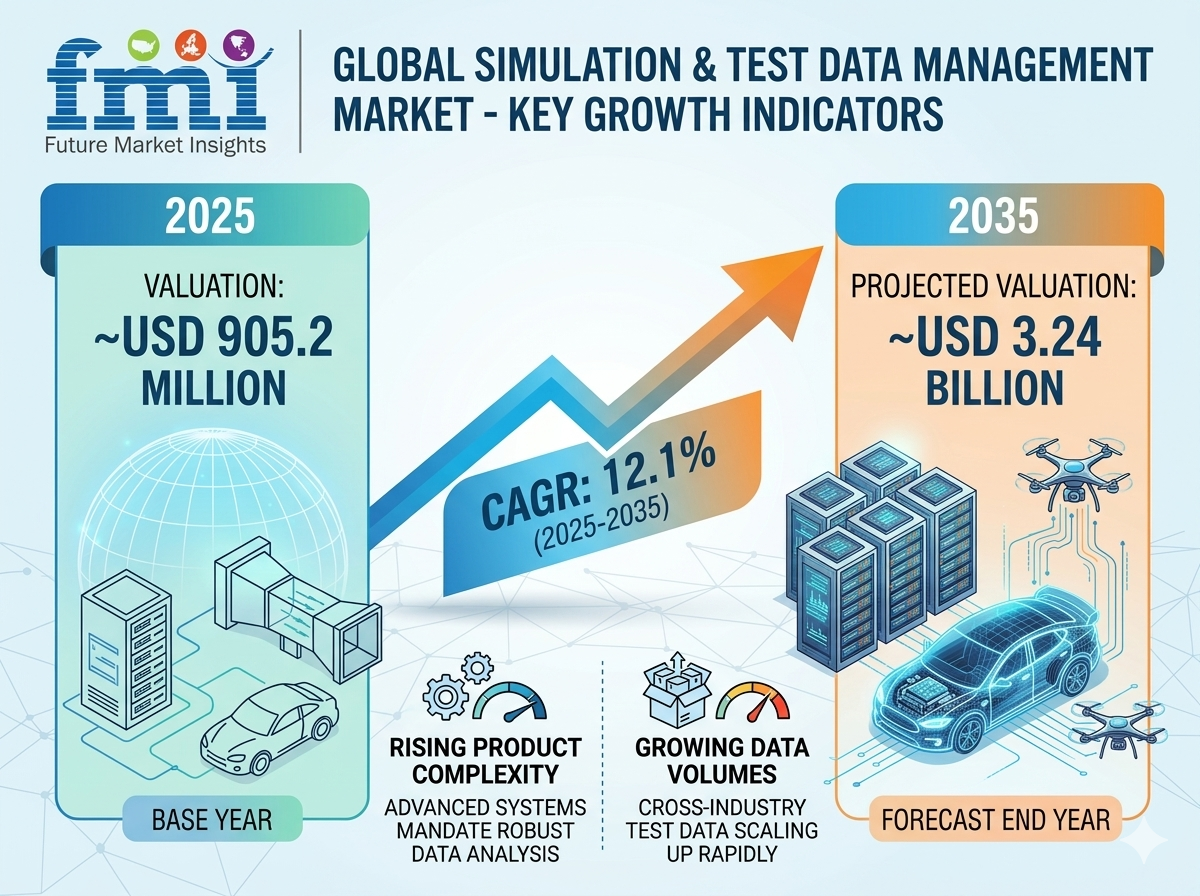
NEWARK, DE, UNITED STATES, March 30, 2026 /EINPresswire.com/ -- The global Simulation and Test Data Management Market is projected to grow from USD 905.2 million in 2025 to USD 3.24 billion by 2035, registering a robust CAGR of 12.1% during the forecast period. Growth is primarily driven by the increasing complexity of product development cycles, the exponential rise in simulation data, and the need for secure, compliant, and scalable data management solutions across industries.
As organizations accelerate digital transformation initiatives, simulation and testing environments are generating vast volumes of structured and unstructured data. This shift is pushing enterprises to adopt advanced data management platforms capable of ensuring data integrity, traceability, and seamless integration across engineering workflows.
Request For Sample Report | Customize Report | Purchase Full Report
https://www.futuremarketinsights.com/reports/sample/rep-gb-1868
Simulation and Test Data Management Market Snapshot (2025–2035)
• Market size in 2025: USD 905.2 million
• Market size in 2035: USD 3.24 billion
• CAGR (2025–2035): ~12.1%
• Leading segment: Test data simulation software
• Top end-use segment: Aerospace & Defense
• Dominant deployment: Cloud-based platforms
• Fastest-growing country: India
• Key companies: K2View, Informatica, IBM, Delphix, DATPROF
Market Momentum
The market begins at USD 905.2 million in 2025, supported by rising adoption of simulation-driven product development across automotive, aerospace, and high-tech industries. Between 2026 and 2030, increasing integration of AI and machine learning in simulation workflows significantly enhances testing accuracy and efficiency.
Entering 2032 and beyond, advancements in digital twin ecosystems, predictive analytics, and real-time monitoring capabilities drive further adoption. Enterprises increasingly rely on cloud-native architectures and automated data pipelines to manage growing data complexity.
By 2035, the market reaches USD 3.24 billion, fueled by widespread deployment across industrial automation, automotive engineering, and advanced R&D environments where precision and speed are critical.
Why the Market is Growing
The Simulation and Test Data Management Market is expanding rapidly as industries prioritize faster innovation cycles, reduced prototype costs, and improved product reliability. The growing use of digital twins and virtual simulations has significantly increased the volume and complexity of test data, making robust data management systems essential.
AI and machine learning technologies are transforming simulation environments by enabling predictive modeling, automated testing, and anomaly detection. These capabilities allow organizations to identify potential failures early in the development process, reducing risks and enhancing product performance.
Additionally, the shift toward cloud-based solutions is enabling enterprises to scale operations efficiently while ensuring accessibility across geographically distributed teams. Cloud platforms also support integration with CI/CD pipelines, enabling continuous testing and development.
However, concerns around data security, compliance, and privacy remain critical, especially in sectors such as healthcare, aerospace, and defense, where data accuracy directly impacts safety and operational outcomes.
Segment Spotlight
1. Solution Type: Test Data Simulation Software Leads
Test data simulation software holds approximately 42.3% market share in 2025, driven by its ability to generate accurate virtual environments for testing. It enables faster iteration cycles, reduces dependency on physical prototypes, and enhances overall product quality.
2. End-Use: Aerospace & Defense Dominates Growth
The aerospace and defense segment is projected to grow at a CAGR of 14.8%, supported by increased reliance on digital engineering and simulation technologies to improve mission readiness and operational efficiency.
3. Deployment: Cloud-Based Platforms Gain Traction
Cloud deployment models are witnessing rapid adoption due to their scalability, flexibility, and cost-efficiency. They are particularly beneficial for organizations managing complex workflows and large datasets across distributed teams.
Drivers, Opportunities, Trends, Challenges
• Drivers: Increasing simulation complexity, rising data volumes, demand for faster product development
• Opportunities: AI-powered analytics, digital twin expansion, cloud-native architectures
• Trends: Real-time monitoring, predictive analytics, integration with CI/CD pipelines
• Challenges: High implementation costs, data privacy concerns, integration complexity
Country Growth Outlook (2025–2035)
India leads the market with a CAGR of 15.8%, driven by rapid adoption of cloud-based simulation tools and strong government support for digital transformation initiatives. China follows at 14.6%, supported by industrial automation and digital twin adoption across manufacturing sectors.
The United States records a CAGR of 13.4%, driven by strict regulatory compliance requirements and increasing demand for secure data management solutions. Germany (11.9%) and Japan (12.1%) show steady growth due to strong industrial automation and engineering capabilities.
Competitive Landscape
The Simulation and Test Data Management Market is highly competitive, with leading players focusing on AI-driven innovation, cloud integration, and real-time analytics capabilities. Companies are investing heavily in automation technologies to enhance scalability and reduce testing costs.
Market participants are differentiating themselves through advanced data governance solutions, improved user interfaces, and seamless integration with existing enterprise systems. Strategic partnerships and acquisitions are also shaping the competitive landscape, enabling companies to expand their capabilities and market reach.
Emerging vendors are introducing niche solutions that address specific industry challenges, contributing to increased innovation and diversity within the market.
Frequently Asked Questions (FAQ)
What is the global Simulation and Test Data Management Market size?
The market is valued at USD 905.2 million in 2025 and is projected to reach USD 3.24 billion by 2035.
At what rate is the market expected to grow?
The market is expected to grow at a CAGR of approximately 12.1% during the forecast period.
What is simulation and test data management?
It refers to solutions that manage, store, and analyze data generated during simulation and testing processes to ensure accuracy, compliance, and efficiency.
Why is this market gaining importance?
The increasing adoption of digital twins, AI-driven simulations, and complex product development processes is driving demand for advanced data management solutions.
Explore More Related Studies Published by FMI Research:
Open Banking Market - https://www.futuremarketinsights.com/reports/open-banking-market
Aerial Imaging Market - https://www.futuremarketinsights.com/reports/aerial-imaging-market
India Digital Commerce Market - https://www.futuremarketinsights.com/reports/india-digital-commerce-market
About Future Market Insights (FMI)
Future Market Insights, Inc. (FMI) is an ESOMAR-certified, ISO 9001:2015 market research and consulting organization, trusted by Fortune 500 companies and global enterprises. With a strong global presence across the U.S., UK, India, and the Middle East, FMI delivers actionable insights and strategic intelligence across diverse industry verticals.
Why Choose FMI:
https://www.futuremarketinsights.com/why-fmi
Sudip Saha
Future Market Insights Inc.
+1 347-918-3531
rahul.singh@futuremarketinsights.com
Legal Disclaimer:
EIN Presswire provides this news content "as is" without warranty of any kind. We do not accept any responsibility or liability for the accuracy, content, images, videos, licenses, completeness, legality, or reliability of the information contained in this article. If you have any complaints or copyright issues related to this article, kindly contact the author above.
