

Regional shipping networks gain as global trade routes realign
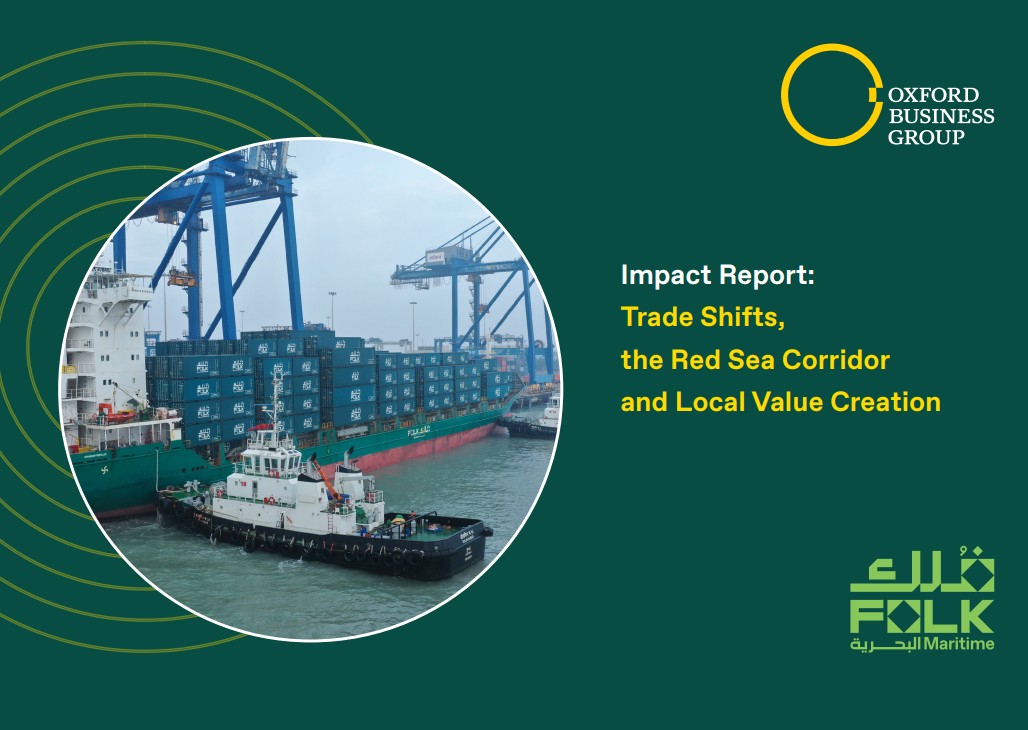
Folk Maritime Impact Report cover

OBG Logo
New Report maps how shifting trade flows are redrawing maritime competitiveness across the Red Sea, Strait of Hormuz, Arabian Gulf and beyond
The Red Sea Corridor is evolving beyond its traditional role as a transit route into a more integrated logistics and industrial ecosystem.”
RIYADH, SAUDI ARABIA, April 17, 2026 /EINPresswire.com/ -- Global trade disruption and realignment are transforming the Red Sea Corridor into a pivotal hub for resilient supply chains, highlighting the importance of investment in infrastructure, technology and localisation to drive long-term value creation, reveals a new impact report by Oxford Business Group (OBG) in partnership with Folk Maritime.— Abdullah Mohammed Alzamil
Titled, "Trade Shifts, the Red Sea Corridor and Local Value Creation,” the impact report examines how evolving trade routes are redefining maritime competitiveness across the Red Sea, the Arabian Gulf, East Africa, India and South-east Asia. It highlights the growing importance of infrastructure development, technology adoption and low-carbon strategies in strengthening resilience and enabling sustainable growth.
The report finds that the reconfiguration of global supply chains is accelerating investment in maritime infrastructure and regional shipping networks, while increasing demand for operational efficiency and digital integration. Governments and private operators are modernising ports, expanding capacity and enhancing connectivity, with Saudi Arabia emerging as a key hub in efforts to strengthen regional and intercontinental trade links.
It also underscores the role of emerging markets in global trade, as shifting logistics patterns create opportunities for greater participation in value-added logistics activities. Rising investment in human capital and local capabilities is supporting service quality and operational efficiency, while contributing to broader economic diversification objectives.
In parallel, the report points to the growing emphasis on sustainability and supply-chain resilience, with operators leveraging technology and scalable solutions to adapt to changing trade conditions and disruption. Regional liners are increasingly positioned as agile complements to global shipping networks, enhancing responsiveness and supporting both local priorities and international development goals.
The report includes an interview with Abdullah Mohammed Alzamil, Chairman, Folk Maritime, in which he evaluates the evolving role of the Red Sea Corridor as a platform for value creation and supply chain resilience. He highlights the opportunity to capture greater value within the region through integrated logistics and infrastructure development.
“The Red Sea Corridor is evolving beyond its traditional role as a transit route into a more integrated logistics and industrial ecosystem. This shift enables the localisation of value-added activities and strengthens regional trade linkages,” Alzamil said.
The publication also includes an interview with Poul Hestbæk, CEO, Folk Maritime, in which he explores how shifting trade dynamics are reshaping maritime logistics and regional shipping networks. He explains that these developments are accelerating the long-term shift towards more adaptable and regionally integrated shipping models.
“Shifting tariffs, Covid-19 legacies and geopolitical disruptions are reshaping global trade, accelerating nearshoring and friendshoring. These dynamics are shortening supply chains, redistributing cargo towards regional flows and driving demand for flexible, personalised services,” Hestbæk said.
Büşra Karacadağ, OBG’s Country Director for Saudi Arabia, said the report highlights the important role of the region and the Kingdom amid disruption in global trade flows.
“The timing of this report matters. Businesses operating across the Red Sea Corridor are no longer asking whether trade routes are shifting. They are asking how fast, and how to position themselves ahead of it. What this research shows is that Saudi Arabia is not just responding to these changes. It is actively shaping them, through infrastructure investment, localisation and a clear long-term vision,” she stated.
The report concludes that enhanced regional collaboration, continued investment in infrastructure and the adoption of sustainable practices will be central to building a more integrated maritime ecosystem across the Red Sea Corridor and beyond. Recent instability in regional shipping and trade flows further underscores the importance of these long‑term shifts, as governments and operators seek to build more resilient and diversified trade corridors.
Impact Report: Trade Shifts, the Red Sea Corridor and Local Value Creation is now available to view and download at: https://www.oxfordbusinessgroup.com/reports/report-trade-shifts-and-value-creation-across-the-red-sea-corridor-middle-east-focus-report/
Marc-André de Blois
About Oxford Business Group
+971 4 426 4642
email us here
Visit us on social media:
LinkedIn
Facebook
YouTube
X
Legal Disclaimer:
EIN Presswire provides this news content "as is" without warranty of any kind. We do not accept any responsibility or liability for the accuracy, content, images, videos, licenses, completeness, legality, or reliability of the information contained in this article. If you have any complaints or copyright issues related to this article, kindly contact the author above.
