

Medical Scheduling Software Market to reach USD 1,595.3 Million by 2035 at 12.90% CAGR
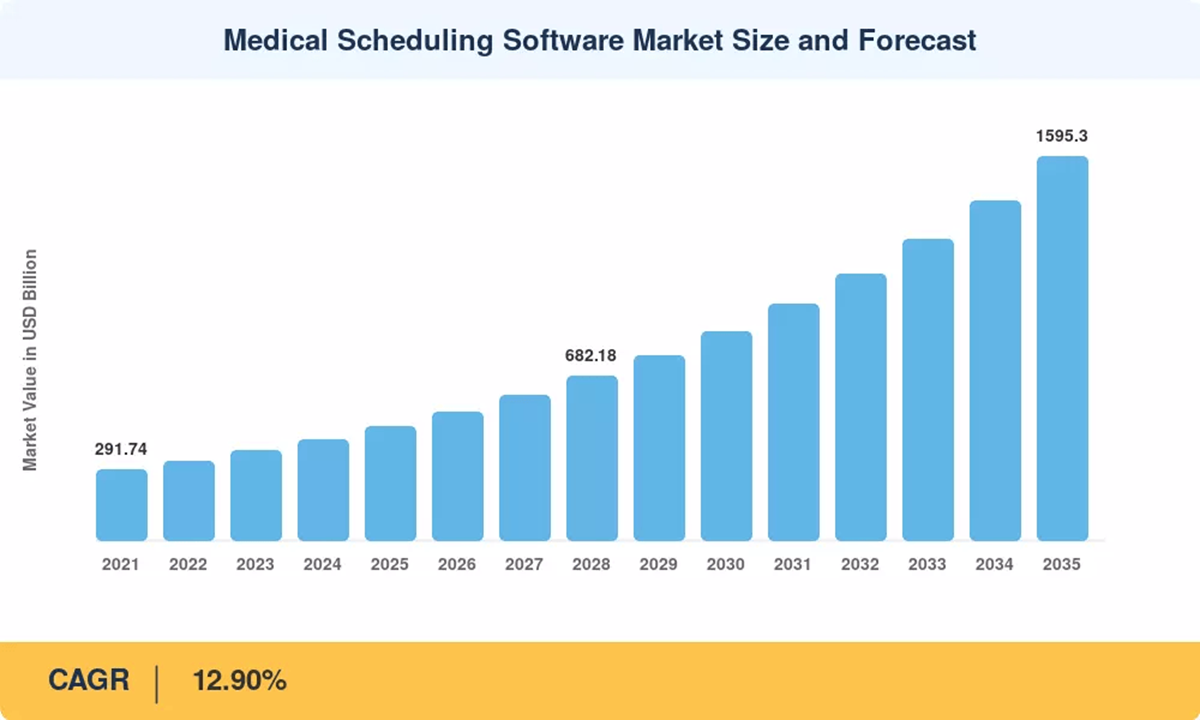
Medical Scheduling Software Market Size
Medical Scheduling Software Market to Surge from $535.1M in 2026 to $1,595.3M by 2035-By Interoperability Mandates & EHR Integration Clinical Workforce Shortage
NY, CA, UNITED STATES, July 13, 2026 /EINPresswire.com/ -- As per Market Research Future, the global Medical Scheduling Software Market size to reach USD 1,595.3 Million by 2035 from USD 535.1 Million in 2026, at a CAGR of 12.90% during the forecast period 2026--2035. The market base was estimated at USD 474.0 Million in 2025.The 12.90% CAGR---anchored by structural healthcare operational demand rather than discretionary spending---is driven by three converging forces: the U.S. Office of the National Coordinator for Health IT's 2024 interoperability mandates, which penalize health systems still relying on siloed calendars and require certified EHR technology to support standardized scheduling APIs aligned with USCDI v3 standards; an acute clinical staffing deficit that the World Health Organization estimates at 10 million workers globally by 2030.
Turning every clinician hour into a scarce resource where double-booking a surgeon or under-utilizing a procedure room represents a measurable financial loss estimated at USD 150,000 per operating room per year in idle-time costs; and surging consumer demand for digital booking, with a 2024 Accenture survey revealing that 78% of patients prefer to book, reschedule, or cancel appointments online while just 52% of U.S. offices offer complete self-service booking. The Medical Scheduling Software Market is no longer a back-office afterthought---it sits at the intersection of regulatory compliance, workforce optimization, and patient experience strategy.
Request A Free Sample: https://www.marketresearchfuture.com/sample_request/33115
Key Market Trends & Growth Drivers
Interoperability Mandates & EHR Integration
The ONC's HTI-1 final rule, effective January 2026, requires certified EHR technology to support standardized scheduling APIs aligned with USCDI v3 standards. This regulatory stick is converting hesitant mid-size hospital networks into active buyers, with scheduling-module RFPs at U.S. group purchasing organizations rising 34% year-over-year in 2024. The mandate's ripple effect extends to Europe, where the European Health Data Space regulation mirrors FHIR-first interoperability requirements by 2027.
FHIR R4 APIs enable real-time bidirectional data exchange, cutting average integration timelines from 9 months to under 12 weeks. Each percentage point of interoperability mandate compliance gain translates into measurable procurement volume, and the regulatory validation paradigm embedded in health IT certification makes this driver structurally durable through 2035.
Clinical Workforce Shortages
The American Hospital Association estimates that the U.S. will be short up to 124,000 physicians by 2034 and 200,000 nurses by 2030. In a setting where every clinician's hour is valuable, double-booking a surgeon or under-utilizing a procedure room is a measurable financial loss, estimated at USD 150,000 per operating room per year in idle-time costs.
Automated scheduling tools that dynamically rebalance provider capacity are moving from 'nice-to-have' to practical necessity, particularly in rural and safety-net hospitals where staffing buffers are thinnest. Early-adopter health systems report that AI-driven scheduling engines reduce average wait times by 18% across specialty departments and cut overtime costs by dynamically matching clinician availability with predicted patient demand.
Consumer Demand for Digital Booking
A 2024 Accenture survey revealed that 78% of patients prefer to book, reschedule, or cancel appointments online, while just 52% of U.S. offices offer complete self-service booking. The gap is the addressable demand of the Medical Scheduling Software Market today. Younger cohorts want an Amazon-like experience. Health institutions that cannot give it will lose commercially insured patients to competitors, immediately eroding margin.
Real-time availability, multilingual interfaces, and SMS confirmation on patient-facing portals are now table-stakes features in new platform evaluations. Health systems deploying patient self-scheduling report 22--30% reductions in call-center volume and 15% lower no-show rates, translating to measurable ROI within 12 months of deployment.
Ask for Customization: https://www.marketresearchfuture.com/ask_for_customize/33115
Market Segment Insights
BY PRODUCT TYPE
Patient Scheduling: Dominant segment with ~62.3% revenue share in 2025. Reflecting widespread adoption of self-service booking portals. Patient scheduling sits at the intersection of consumer expectations and revenue-cycle efficiency. Health systems deploying patient self-scheduling report 22--30% reductions in call-center volume and 15% lower no-show rates, translating to measurable ROI within 12 months of deployment. Epic Cadence and athenaCommunicator anchor this segment.
Care Provider Scheduling: Fastest-growing product class at 13.60% CAGR (2026--2035). Driven by nurse-rostering automation and AI-driven tools that promise to cut overtime costs by dynamically matching clinician availability with predicted patient demand. Rural and critical-access hospitals, where a single nurse absence can cascade into unit closures, are the most aggressive early adopters. As workforce optimization consolidates around intelligent rostering, manufacturers able to supply predictive staffing platforms capture a disproportionate share.
Others (Facility & Equipment Scheduling): 11.2% share in 2025; OR block management, imaging suite allocation, and infusion chair scheduling represent incremental demand channels.
BY DEPLOYMENT MODEL
Cloud-Based: Dominant deployment model with ~73.8% of the Medical Scheduling Software Market in 2025. Reflects a broader industry shift toward subscription-based pricing that converts capital expenditure to operating expenditure. Scalability, lower upfront cost, and the SaaS model make cloud dominance structurally durable. Oracle Health and Athenahealth anchor this segment.
Hybrid: Fastest-growing deployment class at 13.70% CAGR (2026--2035). Privacy-sensitive specialties---behavioral health, oncology, and fertility---are blending on-site control with cloud scalability. Hybrid deployments bridge the compliance gap without sacrificing user experience, as patient-facing booking runs in the cloud while provider-credentialing data stays on-site.
BY END USER
Hospitals: Largest segment at ~52.5% share in 2025, representing roughly USD 248.85 Million. Anchored by the complexity of coordinating operating rooms, imaging suites, infusion chairs, and outpatient clinics under one platform. National hospital procurement through ministries of health and group purchasing organizations dominates volume, channeling enterprise scheduling supply through centralized IT budgets.
Telehealth Providers: Fastest-growing end-user segment at 13.80% CAGR. Hybrid care models require real-time toggling between virtual and physical appointment types. Scheduling platforms that seamlessly switch between telehealth slots and physical rooms---automatically assigning modality based on acuity, patient preference, and provider availability---address a workflow gap that standalone telehealth vendors cannot fill.
BY SPECIALTY
Primary Care: Dominant specialty with ~65.8% of demand in 2025. Generates the highest appointment throughput across any specialty, making it the natural entry point for scheduling platform adoption. Chronic disease management and high visit volume create a structural demand floor.
Behavioral & Mental Health: Fastest-growing specialty segment at 13.90% CAGR. Behavioral health visits surged 38% between 2020 and 2024, yet most mental-health practices still schedule via phone or basic calendar tools. The 988 Suicide & Crisis Lifeline expansion and state-level parity enforcement have dramatically widened access mandates, creating urgent demand for scalable scheduling infrastructure across multi-site group practices. Private-equity-backed behavioral health rollups alone represent a USD 4.2 billion addressable opportunity by 2032.
BY APPLICATION
Appointment Scheduling: Dominant application with ~48% of demand in 2025. The core use case spanning patient self-booking, provider availability management, and automated confirmation workflows.
Patient Management: USD 102.8 Million in 2025; intake automation, demographic verification, and insurance pre-authorization integration.
Read Detailed Insights: https://www.marketresearchfuture.com/reports/medical-scheduling-software-market-33115
Regional Outlook
North America --- Dominant Market (~45.2% Share, 2025)
The United States generates approximately 78.5% of North American Medical Scheduling Software Market revenue, fueled by CMS value-based care incentives that reward operational efficiency and the ONC HTI-1 mandate driving active buyer conversion. U.S. hospitals alone spent an estimated USD 2.4 billion on administrative IT modernization in 2024, with scheduling modules absorbing a growing slice of that budget. Reimbursement breadth and high per-capita health IT spending support premium-priced AI-integrated platform demand that emerging markets cannot match.
Canada contributes 14.2% of regional share through Canada Health Infoway investments of CAD 240 million to digital-health access projects in 2024, with scheduling interoperability as a core pillar, while Mexico's Instituto Mexicano del Seguro Social is piloting cloud-based appointment platforms across 15 metropolitan hospitals at a 13.40% CAGR. North America's leadership rests on payer incentive depth and the structural AI-augmented segment created by expanded digital-front-door strategies and no-show reduction mandates.
Europe --- Second Largest (~25.8% Share, 2025)
Europe's Medical Scheduling Software Market reflects divergent national strategies---Germany leads regionally with the Krankenhauszukunftsgesetz (Hospital Future Act) allocating EUR 4.3 billion for hospital digitization, with scheduling modules qualifying for direct subsidies, representing 22.4% of regional share, while the UK historically used selective hospital targeting before broadening coverage through the NHS App, which processed over 40 million appointment bookings in 2024.
France is growing at 12.50% CAGR on Mon Espace Santé portal integration. Italy contributes 11.3% of regional share through PNRR telemedicine investments. Harmonization pressure from the European Health Data Space regulation is gradually narrowing these differences, lifting baseline demand across the region. The Nordic countries are growing at a steady pace on high digital maturity and single-payer efficiency focus. Spain contributes through regional health system modernization at 12.20% CAGR. Russia holds a smaller share through the federal e-health program.
Asia-Pacific --- Fastest-Growing Region (14.05% CAGR, 2026--2035)
Asia-Pacific is the engine of the Medical Scheduling Software Market. China holds the largest regional share with 31.5% of regional revenue, its Healthy China 2030 initiative channeling central and provincial funding toward smart-hospital platforms, with major tier-one hospitals in Beijing and Shanghai deploying AI-driven scheduling systems since 2023. India is growing at 15.20% CAGR---the fastest-growing country in the region---on the back of the Ayushman Bharat Digital Mission having generated 570 million Ayushman Bharat Health Account IDs, creating a digital backbone that scheduling vendors can plug into.
ASEAN economies show strong growth at 14.80% CAGR as hospital buildout waves and rising middle-class demand converge. Japan contributes USD 14.7 Million through its super-aging population and clinical efficiency mandates. South Korea contributes 13.8% of regional share on the My HealthWay digital platform. The rest of Asia-Pacific is growing on gradual digital adoption. The region's combined contribution anchors the global volume base for cloud-native and mobile-first scheduling demand.
Middle East & Africa --- Emerging Opportunity (3.8% Share, 2025)
The Middle East & Africa carries the widest health IT infrastructure gap and therefore the steepest long-term opportunity. Saudi Arabia leads the region with Vision 2030 smart-hospital cities, contributing 30.2% of regional share. NEOM and King Faisal Specialist Hospital projects are anchoring demand for end-to-end digital scheduling, backed by Vision 2030's allocation of over USD 65 billion for healthcare transformation.
The UAE contributes USD 3.1 Million through Abu Dhabi and Dubai MedTech clusters. South Africa is growing at 12.60% CAGR on NHI rollout planning. Egypt contributes 14.5% of regional share through universal health insurance expansion. The rest of the region is growing steadily on fragmented adoption. Legacy-system integration complexity remains a restraint---38% of facilities in the region still rely on paper-based or basic digital scheduling, and migration timelines average 12--18 months per site.
Competitive Landscape and Recent Developments
The Medical Scheduling Software Market exhibits medium concentration, with an estimated Herfindahl-Hirschman Index in the 800--1,100 range and the top five vendors holding an estimated 42--48% of global revenue. The long tail of niche and specialty-focused vendors creates a fragmented competitive environment beyond the top tier, though M&A activity is consolidating the mid-market segment rapidly.
The competitive landscape is stratified between integrated EHR giants serving large health systems, cloud-native ambulatory specialists capturing independent practice demand, and consumer-facing marketplace platforms consolidating the direct-to-patient booking segment.
KEY COMPANIES AND RECENT MILESTONES
Epic Systems (January 2025): Released an updated Cadence module featuring predictive no-show scoring and automated waitlist backfill, piloted at 14 health systems across the U.S. Integrated EHR-scheduling dominance in large health systems commands ~12--16% of global Medical Scheduling Software Market revenue.
Oracle Health (Cerner) (March 2025): Launched an AI-powered scheduling optimizer integrated natively into the Oracle Health EHR, targeting 20% reduction in appointment gaps for enterprise clients. Enterprise cross-suite play post-Oracle acquisition supports ~9--13% of global revenue.
Athenahealth (September 2024): Expanded athenaCommunicator's self-scheduling to support multilingual interfaces covering 12 languages, addressing health equity gaps in diverse patient populations. Cloud-native ambulatory focus supports ~6--9% of global revenue.
Future Outlook: 2026--2035
By 2030, AI-autonomous operations will become the operating system of medical scheduling. Market Research Future expects at least 35% of scheduling decisions in large health systems to be made autonomously by AI engines by 2029, up from under 5% in 2025. The Medical Scheduling Software Market will shift from 'decision-support' to 'decision-execution,' where algorithms handle rebooking, load-balancing, and conflict resolution without human approval. Machine-learning algorithms that predict no-show probability, optimal appointment duration, and provider-patient matching are reducing no-show rates by 15--25%. Vendors that cannot deliver autonomous workflows risk relegation to commodity status as buyers prioritize measurable efficiency gains.
Platform economics and ecosystem lock-in will reframe cost structures by the early 2030s. The Medical Scheduling Software Market is converging with patient engagement, revenue-cycle management, and workforce-management platforms into unified suites. Vendors with robust API ecosystems and third-party app marketplaces will capture disproportionate lifetime value as switching costs rise. Epic's App Orchard and Oracle Health's marketplace strategies exemplify this platform play, where scheduling becomes the sticky entry point for broader administrative-suite adoption. As per-user costs fall with scale, the addressable channel widens from large health systems to community hospitals and independent physician practices, extending enterprise scheduling beyond traditional settings.
More Related Research Insights:
https://www.marketresearchfuture.com/reports/examination-light-market-42304
https://www.marketresearchfuture.com/reports/stent-market-42233
https://www.marketresearchfuture.com/reports/sezary-syndrome-treatment-market-39395
https://www.marketresearchfuture.com/reports/cranial-and-facial-implants-market-9247
https://www.marketresearchfuture.com/reports/over-the-counter-otc-hearing-aids-market-67491
https://www.marketresearchfuture.com/reports/male-infertility-market-43386
https://www.marketresearchfuture.com/reports/healthcare-equipment-leasing-market-42604
https://www.marketresearchfuture.com/reports/yersiniosis-diagnostics-treatment-market-42382
https://www.marketresearchfuture.com/reports/forensic-genomic-market-29304
https://www.marketresearchfuture.com/reports/male-hypogonadism-market-42043
Larry Wilson
WantStats Research And Media Pvt. Ltd.
+1 855-661-4441
email us here
Visit us on social media:
LinkedIn
Facebook
YouTube
X
Legal Disclaimer:
EIN Presswire provides this news content "as is" without warranty of any kind. We do not accept any responsibility or liability for the accuracy, content, images, videos, licenses, completeness, legality, or reliability of the information contained in this article. If you have any complaints or copyright issues related to this article, kindly contact the author above.
