

Startup founders’ quest for funding to chart their companies’ future
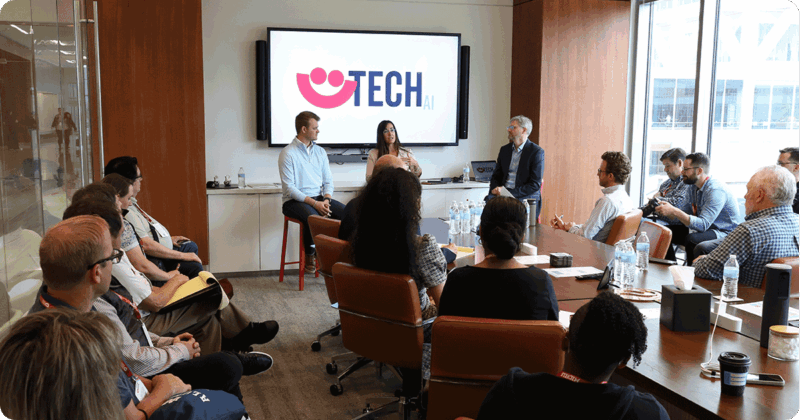
Mason Cook and Laura Strong participate in a panel discussion titled “Midwest Momentum: The New Investment Landscape in Wisconsin and Beyond,” at SummerfestTECH.
For founders of startups, cash is king—but venture capital experts speaking at Milwaukee’s Summerfest Tech in late June urged entrepreneurs to make a thoughtful assessment of their strategic goals and financing objectives before plunging ahead in their drive to raise funds.
Mason Cook, founding partner of Beloit’s Mastercraft Ventures , and Laura Strong, founder and CEO of the Madison-based Valency Fund , gave an overview of potential funding paths and advice for how to achieve funding goals.
The best source of funds depends on goals
Founders can look to many sources for funding—including friends and family, angel investors, venture funds, corporate venture capital, bank loans, debt, and bootstrapping—with each capital source tied to specific business models and exit plans, they said.
“For venture, we look for things that grow rapidly,” said Cook, whose fund typically writes a check of $400,000 to $500,000 when investing in a company’s first funding round. “We invest for equity. How do we make that money back? It’s when a company sells. … We’re looking for an exit. That’s how you cash out.”
Looking beyond the first funding round
Strong, whose fund looks for companies with at least $200,000 in annual revenue as a signal of product-market fit, agreed.
“A venture capitalist wants to come in, and maybe they don’t care about your profitability, but they want to see your revenue growing because whoever acquires you is going to set their price based on your revenue,” said Strong, whose fund seeks advanced manufacturing, agribusiness, and technology firms that are scalable and have high-margin products.
Cook said Mastercraft cares about profitability but goes well beyond that in assessing a company’s viability for funding. He seeks growth ahead of a company, not behind it.
“We do care deeply about the durability of a company. If a company comes to me and says they are going to be wildly profitable, that doesn’t generate a return for me,” he said. “We want to invest in amazing new technologies that are changing the world, but there has to be durability to that, based on the markets placing their dollars and voting that this has value for society.”
Strong urged entrepreneurs to look to the future, well beyond initial-stage funding.
“You have to think through not just how you’re going to get the money for that first step, but how you’re going to get the money for the second, third, and fourth step—because those things can really help you understand where you should get the money for the first step,” she said.
Legal Disclaimer:
EIN Presswire provides this news content "as is" without warranty of any kind. We do not accept any responsibility or liability for the accuracy, content, images, videos, licenses, completeness, legality, or reliability of the information contained in this article. If you have any complaints or copyright issues related to this article, kindly contact the author above.
